I
Interlayer material

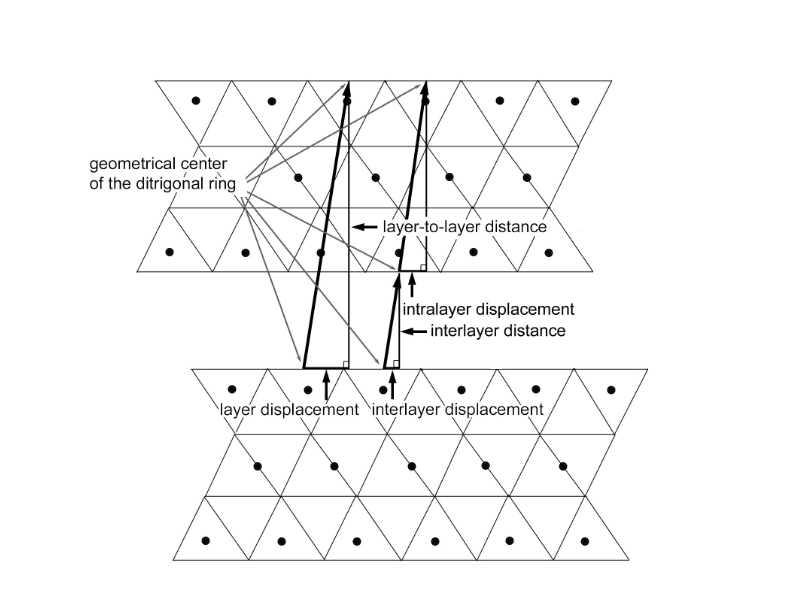
For phyllosilicates, interlayer material separates the 1:1 or 2:1 layers and generally may consist of cations, hydrated cations, organic material, hydroxide octahedra, and/or hydroxide octahedral sheets (see fig. 2). The interlayer material offsets the net negative charge of the layer. In certain cases (e.g., talc, pyrophyllite, where the net layer charge is zero), there is no interlayer material, and an interlayer separating the layers is empty. After Guggenheim et al. (2006).
Cf., layer

interlayer-deficient mica

abbreviated from interlayer-cation-deficient mica (Rieder et al., 1998). A group name for platy phyllosilicates of 2:1 layer and a layer charge of between -0.6 to -0.85 per formula unit. Interlayer-deficient micas do not have swelling capacity. The subgroups of the brittle micas are based on dioctahedral or trioctahedral character (wonesite is the only known member of the trioctahedral subgroup), and species within the subgroups are based on chemical composition. The value of -0.6 is a general limit, as wonesite appears to be an exception with a layer charge of -0.5, although it has no swelling capacity. The value of -0.85 has been fixed from examples of dioctahedral species only. Previous to Rieder et al. (1998), the term “hydromica” was used to express a perceived excess in H2O above the O10(OH)2 formula unit, but these phases are either interstratifications (e.g., hydrobiotite = interstratification of biotite and vermiculite) or micas that exhibit a deficiency in interlayer cation occupancy. Thus, the term “hydromica” was abandoned in favor of interlayer-deficient mica. The term for species “hydrobiotite” was confusing, and the use of the prefix “hydro” is now avoided. Cf., mica, true mica, brittle mica, group names

Interlayer-deficient mica

Abbreviated from interlayer-cation-deficient mica (Rieder et al., 1998). A group name for platy phyllosilicates of 2:1 layer and a layer charge of between -0.6 to -0.85 per formula unit. Interlayer-deficient micas do not have swelling capacity. The subgroups of the brittle micas are based on dioctahedral or trioctahedral character (wonesite is the only known member of the trioctahedral subgroup), and species within the subgroups are based on chemical composition. The value of -0.6 is a general limit, as wonesite appears to be an exception with a layer charge of -0.5, although it has no swelling capacity. The value of -0.85 has been fixed from examples of dioctahedral species only. Previous to Rieder et al. (1998), the term “hydromica” was used to express a perceived excess in H2O above the O10(OH)2 formula unit, but these phases are either interstratifications (e.g., hydrobiotite = interstratification of biotite and vermiculite) or micas that exhibit a deficiency in interlayer cation occupancy. Thus, the term “hydromica” was abandoned in favor of interlayer-deficient mica. The term for species “hydrobiotite” was confusing, and the use of the prefix “hydro” is now avoided.
Cf., mica, true mica, brittle mica, group names
interparticle diffraction

a concept introduced by Nadeau et al. (1984) which theorizes that individual clay mineral particles of oriented samples used in X-ray diffraction studies are stacked in aggregated composite particles which coherently scatter radiation so as to give rise to 00l diffraction patterns similar to those of uncleaved McEwan crystallites. The composite particles are theorized to be produced during sample preparation following disaggregation of original rock or soil samples.

Interparticle diffraction

A concept introduced by Nadeau et al. (1984) which theorizes that individual clay mineral particles of oriented samples used in X-ray diffraction studies are stacked in aggregated composite particles which coherently scatter radiation so as to give rise to 00l diffraction patterns similar to those of uncleaved McEwan crystallites. The composite particles are theorized to be produced during sample preparation following disaggregation of original rock or soil samples.

interstratification

a clay material where two or more kinds of layers are interleaved in a coherently diffracting structural domain with a degree of ordering which may vary from random to completely ordered. Layers may be 1:1 layers or 2:1 layers and interlayers may be of swelling or non-swelling nature. X-ray diffraction and transmission electron diffraction (TEM) are two common techniques used to determine layer proportions and regularity of interleaving. Energy dispersive techniques are commonly used to obtain chemical information. Regular interstratifications may be designated as mineral species, provided that they conform to specific criteria as specified by the International Mineralogical Association. Non-regular interstratifications are commonly characterized according to the information available, e.g., mica-smectite irregular interstratification, and do not warrant species status.

Interstratification

A clay material where two or more kinds of layers are interleaved in a coherently diffracting structural domain with a degree of ordering which may vary from random to completely ordered. Layers may be 1:1 layers or 2:1 layers and interlayers may be of swelling or non-swelling nature. X-ray diffraction and transmission electron diffraction (TEM) are two common techniques used to determine layer proportions and regularity of interleaving. Energy dispersive techniques are commonly used to obtain chemical information. Regular interstratifications may be designated as mineral species, provided that they conform to specific criteria as specified by the International Mineralogical Association. Non-regular interstratifications are commonly characterized according to the information available, e.g., mica-smectite irregular interstratification, and do not warrant species status.

Interstratification

A clay material where two or more kinds of layers are interleaved in a coherently diffracting structural domain with a degree of ordering which may vary from random to completely ordered. Layers may be 1:1 layers or 2:1 layers and interlayers may be of swelling or non-swelling nature. X-ray diffraction and transmission electron diffraction (TEM) are two common techniques used to determine layer proportions and regularity of interleaving. Energy dispersive techniques are commonly used to obtain chemical information. Regular interstratifications may be designated as mineral species, provided that they conform to specific criteria as specified by the International Mineralogical Association. Non-regular interstratifications are commonly characterized according to the information available, e.g., mica-smectite irregular interstratification, and do not warrant species status.

intracrystalline swelling

Intracrystalline swelling involves an increase in the layer-to-layer spacing of a phyllosilicate mineral to accommodate H2O or other molecules in the interlayer. For example, in swelling clays, an increase in the relative humidity around the clay mineral particle, causes interlayer expansion, resulting in partially or fully hydrated interlayer ions. Cf., osmotic swelling

Intracrystalline swelling

Intracrystalline swelling involves an increase in the layer-to-layer spacing of a phyllosilicate mineral to accommodate H2O or other molecules in the interlayer. For example, in swelling clays, an increase in the relative humidity around the clay mineral particle, causes interlayer expansion, resulting in partially or fully hydrated interlayer ions.
Cf., osmotic swelling