U
Udden-Wentworth scale

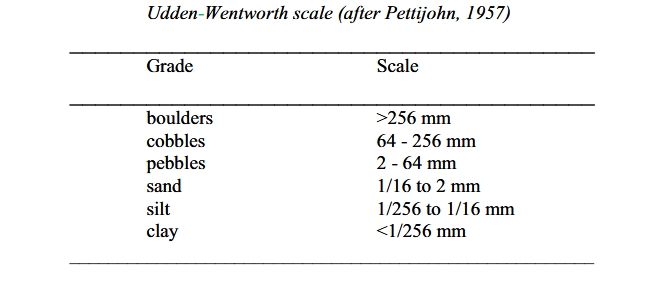
The Udden-Wentworth scale (often referred to as the Wentworth scale) is a size scale (diameter) for clasts and is used primarily in sedimentology and related disciplines. The Udden-Wentworth scale considers size only and does not imply composition. The “clay” term in the scale has the potential to be confusing because “clay” is defined in clay mineralogy as having specific properties unrelated to particle size alone. Thus, to avoid confusion, use of “clay size” instead of “clay” is recommended here to delineate size characteristics of particles only. Further divisions, such as “fine”, “medium”, “coarse”, etc. may be used also. Pettijohn (1957) discusses the history of the use of size terms, alternative classification schemes, and modifications to the nomenclature.
See clay
Underclay

A fine-particle sedimentary seat rock composed mainly of clay minerals, that is generally non-bedded and contains traces of plant roots. Kaolinite-rich underclay deposits are economically important for ceramics manufacturing. (modified from Huddle and Patterson, 1961)
Cf., seat rock, ball clay, flint clay, fire clay

Undrained shear

The loading and shearing of a clay or soil where the pore fluids are confined. Thus, during undrained shearing of a clay, the pore fluid pressure may change, but the total clay volume does not change.

Undrained shear strength

The peak shear resistance or shear stress of a clay or soil that experiences no loss in pore water when subject to loading or unloading. When the applied stress exceeds the undrained shear strength, the clay or soil fails without drainage or exchange of pore water with materials outside the clay/soil mass.

Unghwarit

An obsolete term for nontronite or a mixture of nontronite and silica (opal-C?).

Uniaxial mica

A poorly defined material, possibly biotite.

Unit cell

A unit cell is the smallest repeating parallelipiped (= reduced cell) that contains the atomic structure of a crystal. The unit cell contains a crystals full symmetry and chemical composition and is chosen with cell edges (a, b, c) coinciding with any symmetry axes present. The unit cell is determined by X-ray diffraction, usually from a single crystal.
Cf., cell parameters, unit structure, X-ray diffraction.

Unit structure

For phyllosilicates, the unit structure is the total assembly of the layer and any interlayer material. After Guggenheim et al. (2006) and references therein.
Cf., layer, interlayer material

Unit weight, effective

In soil science, for saturated soils or soils beneath the groundwater table,the effective unit weight is the difference between the total unit weight of the soil mass and the unit weight of water. Thus, the effective unit weight removes the effect of the pore water within the soil mass. One difficulty in its measurement is the determination of loosely held H2O between clay layers vs H2O between grains (i.e., pores).
Syn., buoyant unit weight, submerged unit weight.