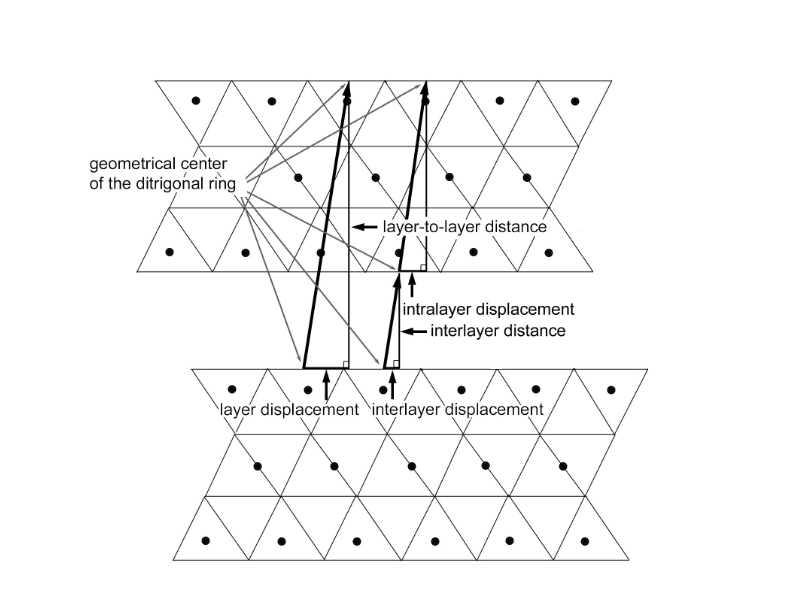
Intercalation is a general term to describe the movement of atoms, ions or molecules into a layered host structure, often a swelling clay mineral. This process can be reversible or non-reversible. The host-structure layers are essentially unchanged with the inserted material going between the layers. The layers must remain semi-contiguous via stacking. Intercalation commonly involves cation exchange or solvation reactions. Intercalation may involve, for example, H2O molecules or surfactants of single planes (monolayers) to paraffin-type layers between the layers of the host phase. The resulting structure is an “intercalated structure”.
See delamination, exfoliation. (From AIPEA Nomenclature Committee, 2011, unpublished)