Binding site, clay mineral

A site on a clay mineral surface available for electrostatic attraction between oppositely charged species, including metal coordination bonding, and anion or polar molecule attractions, etc. Binding sites commonly occur: (1) where bonds are broken at particle edges (terminal edges) leaving a net positive charge and a possible under-bonded arrangement where bond lengths adjust accordingly to approach overall charge balance. Alternatively, any anion may compensate for the broken bond, with (OH) most common (and thus these sites may be affected by pH). (2) to charge balance isomorphous substitutions that occur within the 2:1 or 1:1 layer, for example, cations in the interlayer of smectite compensate for the (permanent) negative layer charge on the basal plane atoms.
Cf., edge site
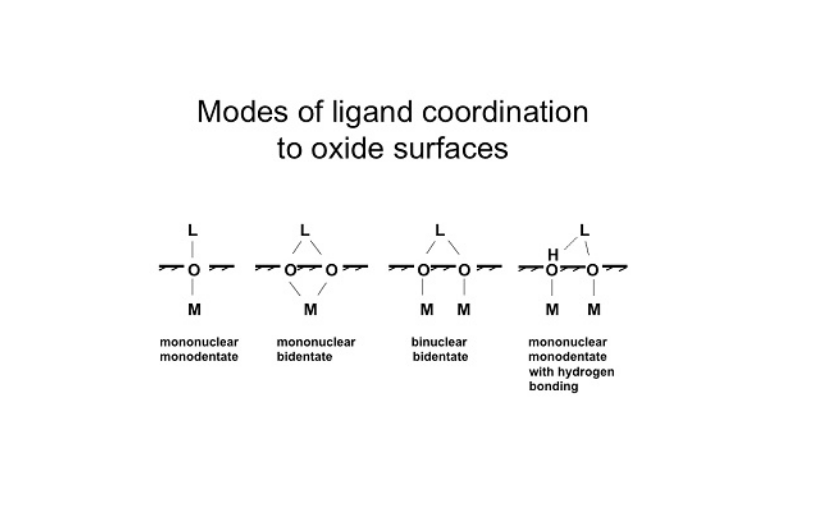
Binuclear complex

A binuclear complex refers an entity of atoms (i.e., a complex or more appropriately, a molecular entity or coordination entity) with two central ions (by extension, a mononuclear complex has one central ion, a trinuclear complex has three, and polynuclear complexes have more than three). The central ion is a metal ion and an electron acceptor, with ligands as electron donors. If surface sites are involved, binuclear refers to a ligand (L) binding to two metal (M) surface sites; if a ligand is bound to only one site, the adsorption complex is termed mononuclear. See figure below.

binuclear_complex_figure_1

Figure 1. Illustration of mononuclear and binuclear (inner-sphere)
complexes of adsorbed metal ions on a surface.
From Maurice (2009), with permission.

See binuclear complex.

Bioaccumulation

A process whereby an element or compound is incorporated into or concentrated on the surface of an organism, possibly transformed into another compound, and retained. The concentration of the element(s) or compound(s) in the biota may be greater than its concentration in the media from which it was derived. The process is of particular concern for toxins, pesticides, etc.

Biofilm

A microbial community generally supported by a surface and held together by extracellular attachment features such as exopolysaccharides (EPS) in a distinct 3-dimensional shape or architecture. Biofilm matrix may also include abiotic components, such as clay or other mineral particles, corrosion products, etc. that may act as support and/or as sources of nutrients.

Biological weathering

A biological process that produces either a chemical or physical breakdown of minerals or rocks.
See weathering, physical weathering, chemical weathering

Biologically controlled mineralization

A biomineralization process where the cellular activities of an organism directly control mineral nucleation and growth, the location of nucleation, and mineral morphology. The process may be extracellular, intercellular, or intracellular. Traditional definitions of minerals preclude a biological-process origin of minerals, but such definitions are being challenged, see the definition of “mineral” for a more classic approach.
Cf., mineral, biologically induced mineralization, biomineralization

Biologically induced mineralization

A biomineralizaton process where solution conditions and/or surfaces for heterogeneous nucleation are altered by the cell to promote mineralization. However, the cell does not directly control the type of mineral formed or habit. Traditional definitions of minerals preclude a biological-process origin of minerals, but such definitions are being challenged, see the definition of “mineral” for a more classic approach.
Cf., biomineralization, biologically controlled mineralization, mineral,

Biomineralization

The process whereby living organisms catalyze or otherwise mediate mineral formation. Traditional definitions of minerals preclude a biological-process origin of minerals, but such definitions are being challenged, see the definition of “mineral” for a more classic approach.
Cf., biologically controlled mineralization, biologically induced mineralization, biomineralization, mineral

Biotite

Defined by Rieder et al. (1998) as a trioctahedral mica between, or close to, the annite- phlogopite (i.e., ferrous iron and magnesium substitutions) and siderophyllite-eastonite (i.e., Al rich) joins. The term grandfathers the use of “biotite” in the field, when a chemical analysis is unavailable to describe a dark mica, presumably without Li.

Birefringence

An optical property whereby a crystal has more than one index of refraction. An optically clear calcite rhombohedron shows a doubling of images as a result of birefringence, i.e., double refraction.