Binuclear complex

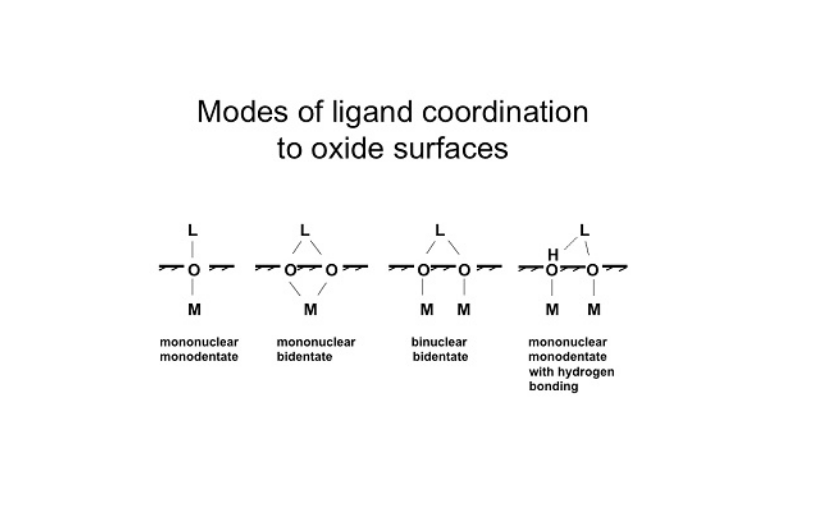
A binuclear complex refers an entity of atoms (i.e., a complex or more appropriately, a molecular entity or coordination entity) with two central ions (by extension, a mononuclear complex has one central ion, a trinuclear complex has three, and polynuclear complexes have more than three). The central ion is a metal ion and an electron acceptor, with ligands as electron donors. If surface sites are involved, binuclear refers to a ligand (L) binding to two metal (M) surface sites; if a ligand is bound to only one site, the adsorption complex is termed mononuclear. See figure below.

binuclear_complex_figure_1

Figure 1. Illustration of mononuclear and binuclear (inner-sphere)
complexes of adsorbed metal ions on a surface.
From Maurice (2009), with permission.

See binuclear complex.

Bioaccumulation

A process whereby an element or compound is incorporated into or concentrated on the surface of an organism, possibly transformed into another compound, and retained. The concentration of the element(s) or compound(s) in the biota may be greater than its concentration in the media from which it was derived. The process is of particular concern for toxins, pesticides, etc.

Biofilm

A microbial community generally supported by a surface and held together by extracellular attachment features such as exopolysaccharides (EPS) in a distinct 3-dimensional shape or architecture. Biofilm matrix may also include abiotic components, such as clay or other mineral particles, corrosion products, etc. that may act as support and/or as sources of nutrients.

Biological weathering

A biological process that produces either a chemical or physical breakdown of minerals or rocks.
See weathering, physical weathering, chemical weathering

Biologically controlled mineralization

A biomineralization process where the cellular activities of an organism directly control mineral nucleation and growth, the location of nucleation, and mineral morphology. The process may be extracellular, intercellular, or intracellular. Traditional definitions of minerals preclude a biological-process origin of minerals, but such definitions are being challenged, see the definition of “mineral” for a more classic approach.
Cf., mineral, biologically induced mineralization, biomineralization

Biologically induced mineralization

A biomineralizaton process where solution conditions and/or surfaces for heterogeneous nucleation are altered by the cell to promote mineralization. However, the cell does not directly control the type of mineral formed or habit. Traditional definitions of minerals preclude a biological-process origin of minerals, but such definitions are being challenged, see the definition of “mineral” for a more classic approach.
Cf., biomineralization, biologically controlled mineralization, mineral,

Biomineralization

The process whereby living organisms catalyze or otherwise mediate mineral formation. Traditional definitions of minerals preclude a biological-process origin of minerals, but such definitions are being challenged, see the definition of “mineral” for a more classic approach.
Cf., biologically controlled mineralization, biologically induced mineralization, biomineralization, mineral

Biotite

Defined by Rieder et al. (1998) as a trioctahedral mica between, or close to, the annite- phlogopite (i.e., ferrous iron and magnesium substitutions) and siderophyllite-eastonite (i.e., Al rich) joins. The term grandfathers the use of “biotite” in the field, when a chemical analysis is unavailable to describe a dark mica, presumably without Li.

Birefringence

An optical property whereby a crystal has more than one index of refraction. An optically clear calcite rhombohedron shows a doubling of images as a result of birefringence, i.e., double refraction.

Birnessite

A layered manganese oxide mineral (phyllomanganate) similar in structure to chalcophanite. The formula of a synthetic sample used in a structure determination (Post and Veblen, 1990) is Mg0.29Mn4+1.42Mn3+0.58O4 . 1.7H2O, assuming no Mn vacancies and an analysis total of 100%. Chalcophanite has a sheet of edge sharing Mn-O octahedra where one in seven octahedra is vacant. Zn cations are located above and below the vacant sites, also in octahedral coordination, with oxygen atoms from the octahedral sheet and from a plane of H2O molecules between the Mn-O sheets. Interlayer cations in birnessite, Mg, Na, K, Ca, etc., may occupy the Zn site and/or H2O sites (as found in chalcophanite). However, distributions of the interlayer cation and H2O sites in birnessite may also differ for various compositions (e.g., Na- vs Mg-rich birnessite), and the occupancy of the interlayer cation/H2O sites is believed to produce observed superstructures. Cation exchange and redox reactions can occur in birnessite. Ranceite is the (interlayer cation) Ca end member of birnessite and takanelite has Mn2+ as the interlayer cation. “Buserite” is a hydrated form of birnessite with a 10-Å spacing instead of the 7-Å value of birnessite. “Buserite” has not been found in nature and is not a mineral, but is a common phase during synthesis of birnessite. Birnessite is a major Mn-rich phase in many soils, in desert varnish, in ocean manganese nodules, and as an alteration product in Mn-rich ore deposits. Australian soils containing birnessite may be related to neutral to slightly alkaline conditions, but this result is not universal and the presence of birnessite may instead be related to a paucity of Ca and Mg of these soils.