Trimethylphenylammonium organoclay

Low-charge smectite (e.g., SWy-1, SWy-2) treated with trimethylphenylammonium chloride (= phenyltrimethylammonium chloride) or trimethylammonium chloride yield organoclays that can effectively remove nonionic organic contaminants from water (Lee et al., 1990; Jaynes and Boyd 1990).

Trioctahedral chlorite

A species of the chlorite mineral group with trioctahedral sheets only. This is the common form of chlorite.
Cf., dioctahedral chlorite, di,trioctahedral chlorite, trioctahedral sheet

Trioctahedral illite

A poorly defined material, possibly interstratified biotite and vermiculite.

Trioctahedral sheet

In the ideal case, the smallest structural unit contains three octahedra. If two such sites are occupied with cations and one site is vacant, then the octahedral sheet is considered “dioctahedral”. If all three sites are occupied, the sheet is considered “trioctahedral”. (Quot Guggenheim et al., 2006; see also references therein). A trioctahedral sheet generally contains predominantly divalent cations.
Cf., dioctahedral sheet

Trisilicic

An invalid term, previously used as a classification of the micas where the number of silicon atoms per formula unit is three per four tetrahedral sites.
See Rieder et al. (1998). Cf., mica, true mica, brittle mica, interlayer-deficient mica, group names.

True mica

A group name for platy phyllosilicates of 2:1 layer and a layer charge of ~ -1.0 per formula unit. True micas do not show swelling capacity. Rieder et al. (1998) defines the true micas as having greater than 50% of the interlayer cations as univalent cations. The true mica group is further divided into subgroups based on the octahedral sheet being either trioctahedral or dioctahedral.
Cf., mica, brittle mica, interlayer-deficient mica, group names

Truscottite
Tuperssuatsiaite

A member of the palygorskite-sepiolite group with a composition of approximately Na1.87Fe2.14Mn0.48Ti0.14 (Si8O20) (OH)2.n(H2O).
See palygorskite-sepiolite group

Turbostratic stacking

In phyllosilicates, turbostratic stacking involves highly disordered (non regular) stacking arrangements of layers where there is no registry from one layer to another, much like a stack of playing cards lying flat on each other but with no alignment of edges. Smectite minerals and halloysite commonly have turbostratic stacking.
See rotational stacking disorder

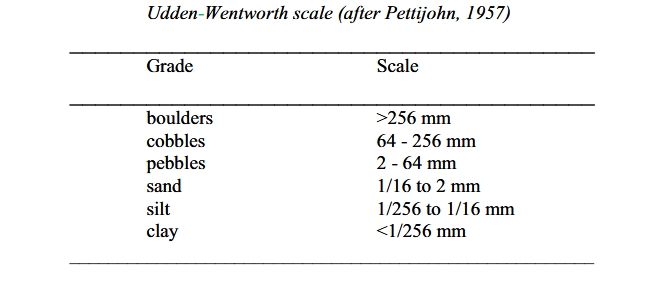
Udden-Wentworth scale

The Udden-Wentworth scale (often referred to as the Wentworth scale) is a size scale (diameter) for clasts and is used primarily in sedimentology and related disciplines. The Udden-Wentworth scale considers size only and does not imply composition. The “clay” term in the scale has the potential to be confusing because “clay” is defined in clay mineralogy as having specific properties unrelated to particle size alone. Thus, to avoid confusion, use of “clay size” instead of “clay” is recommended here to delineate size characteristics of particles only. Further divisions, such as “fine”, “medium”, “coarse”, etc. may be used also. Pettijohn (1957) discusses the history of the use of size terms, alternative classification schemes, and modifications to the nomenclature.
See clay