Point group

The ten basic operations (center of symmetry, mirror plane, proper and improper rotation axes) and their 22 allowable combinations (total = 32) are called “point groups” or “crystal classes”. A combination is allowable only if “closure” is produced. See “rotation symmetry” for the definition of “closure”.

Point of zero charge (pzc or zeropoint of charge)

The pH value of a solution where the negative variable charge equals the positive variable charge for a mineral. The variable charge results from unsatisfied bonds at grain boundaries and any compensating negative (OH) or positive (H+) ions, and thus is a function of the solution surrounding the mineral grain. The variable charge of a phyllosilicate involves the edges of the particle, whereas the layer charge is the “permanent charge” and not of interest in determining the point of zero charge (“total charge” is the sum of the variable and permanent charges). Surface properties change with the presence and types of ions satisfying the residual charges at the crystal surfaces. For example, the type of ions attaching to the surface can affect flocculation/dispersion properties and therefore, sedimentation rates. Sposito (1998) defines the point of zero charge more succinctly as “the pH value of a solution, where the net surface charge of a particle is zero”. The point of zero charge should not be confused with the “point of zero net proton charge”, which refers to particles where only protons are charge determining. The point of zero charge is not necessarily identical to the isoelectric point (iep), in part because of how they are derived experimentally. The point of zero charge is usually determined from titrations at various ionic strengths, which yield intersecting curves at a single point (the “common intersection point”) which, in the absence of sorption of other charge-determining ions, is identical to the point of zero charge. The iep is determined by electrokinetic methods as the pH where the particle mobility is zero. Both points are only identical if specific adsorption of other ions is absent.

Polarizability

The ability of an atom, ion, or molecule to become polarized (where there is a distortion of its charge distribution). For example, an anion has greater polarizability than a cation because of the tendency of the electron cloud about an anion to be easily distorted by a local electric field. Generally, an anion is unable to hold its outer electrons tightly and therefore it is more readily polarizable than a cation. For a monoatomic atom or ion and some molecules, the polarization vector P has the same direction as the applied electric field vector E, and P = αE, where α is the polarizability. If a molecule has an anisotropic polarizability, that is the polarization P may not follow the direction of the applied electric field E, the polarizability α is a symmetric tensor, and the polarization P is given as:
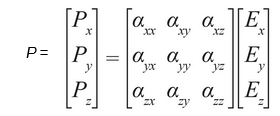
and because the polarizability tensor is symmetric: alpha(xy) = alpha(yx), alpha(xz) = alpha(zx), and alpha(yz)=alpha(zy).
Cf., polarization, dipole moment

Polarization

Polarization is the distortion of the charge distribution about an ion or molecule. In effect, the electron cloud about, for example, an anion can become distorted by a neighboring cation, thereby affecting their determined ionic radii. The anion, now polarized by the cation, shares its electrons with the cation and covalent character increases. Polarization may be temporary if the electric field is temporary, and thus a temporary dipole moment may form.
Cf., polarizability

Polianite

The obsolete term “polianite” was once used to refer to crystalline pyrolusite, which was assumed to be a different species than earthy to “crusty” pyrolusite.

Poly-irvingite

An obsolete varietal term for lepidolite.

Polylithionite

A trioctahedral member of the true mica group. The end-member formula is KLi2AlSi4O10F2, and polylithionite forms a series with siderophyllite. Polylithionite forms as 1M, 2M2, 3T, and 2M1 polytypes and occurs in granitic pegmatites, including pegmatites at Mont St. Hilaire, Quebec, Canada, and the Kola Peninsula, Russia.

Polymer

A chemical compound composed of a very large number of atoms (often hundreds or thousands) forming chains, cycles or other structures. Polymers form by a polymerization process (typically with carbon or aluminum atoms) where smaller units are bound together to form larger units. According to IUPAC, a minor change of the number of integrated atoms does not cause a significant change in the properties of the polymer, and this characteristic distinguishes polymers from oligomers. In clay science publications, oligomers are commonly mistaken for polymers.
Cf., geopolymer, oligomer, polymerization

Polymerization

Polymerization is a process involving a poly-condensation reaction, where smaller units of atoms are bound together to form a chemical compound composed of larger numbers of these units. The resulting compounds are called oligomers or polymers. Synthetic geopolymers (geotechnical engineering), minerals forming various interlayer oligomers in hydroxy-interlayered smectite (clay/soil science), and silicate mineral formation (metamorphic geology) are some examples that involve the polymerization processes.
Cf., geopolymer, hydroxy-interlayered minerals, oligomer, polymer

Polymorphism

The ability of a given element or compound to crystallize in more than one form, with each form having a distinct crystal structure.
Cf., polytypism