In clay science, a macropore (Figure 3) is a cavity among clay particles or aggregates with a diameter of >50 nm, in accord with IUPAC convention (Rouquerol et al., 1994). In soil science, a macropore is defined as a cavity among aggregates with a diameter of >75 μm (Soil Science Society of America, 1997). The pore volume (or pore size) distribution of clays is commonly determined by gas adsorption methods (typically H2O or N2), whereas in soil science/physics, it is usually determined by mercury intrusion porosimetry (MIP) technique.
Cf., mesopore, micropore
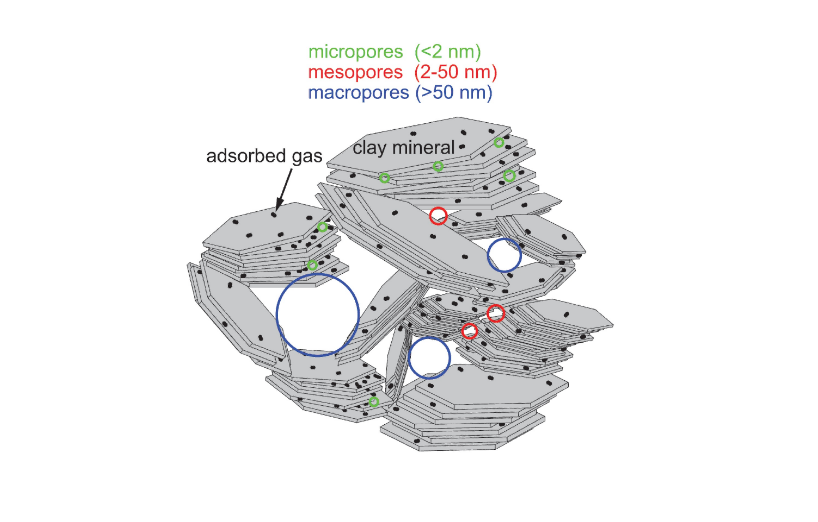
Figure 3. Schematic illustrating micropores, mesopores, and macropores in an aggregate of clay mineral particles. Whereas macropores occur between stacks of clay particles, micropores exist at the edges of clay particles and stacks, often relating to partially bent edges, translational disorder, and/or rotational disorder. Adsorbed gas molecules are illustrated by nitrogen molecules, a common gas used for gas adsorption methods.